
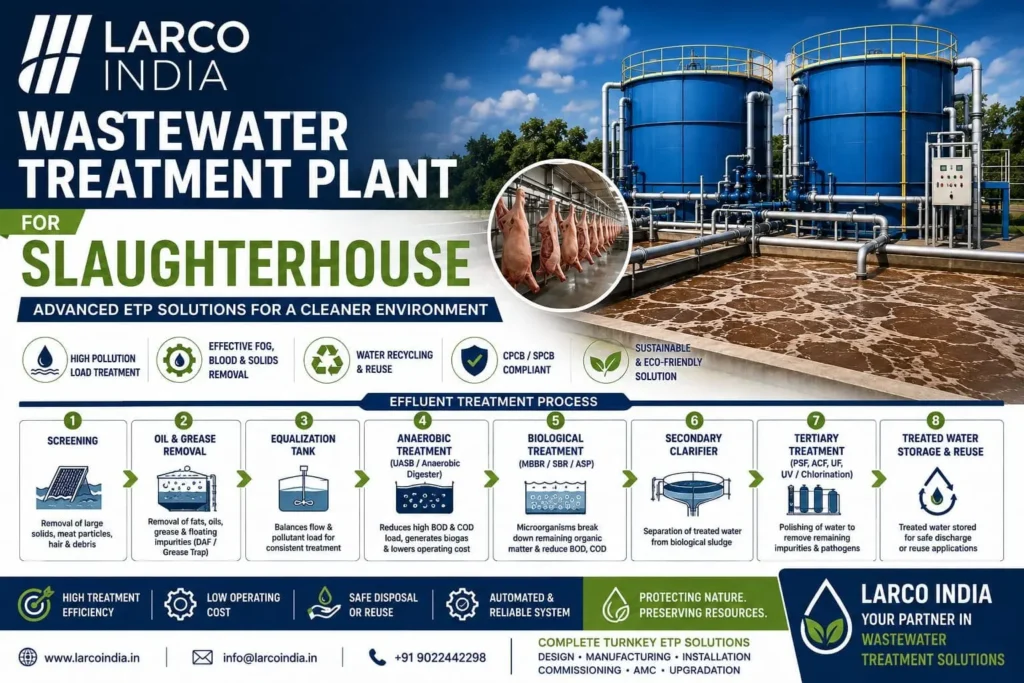
Wastewater Treatment Plant for Slaughterhouse: Complete ETP Solutions for Meat Processing Industry
The meat processing and slaughterhouse industry generates large volumes of wastewater containing blood, fats, oils, grease (FOG), proteins, suspended solids, organic matter, and cleaning chemicals. If this wastewater is discharged without proper treatment, it can cause severe environmental pollution and violate pollution control regulations.
A Wastewater Treatment Plant for Slaughterhouse is specifically designed to treat high-strength wastewater, reduce pollutants, and enable safe discharge or water reuse. At LARCO India, we provide customized Effluent Treatment Plant (ETP) solutions that help slaughterhouses operate efficiently while meeting environmental standards.
Why is Wastewater Treatment Important for Slaughterhouses?
Slaughterhouse wastewater has one of the highest organic pollution loads among food processing industries. It contains:
- Blood and animal tissue
- Fats, oils, and grease (FOG)
- Proteins
- Suspended solids
- High BOD (Biological Oxygen Demand)
- High COD (Chemical Oxygen Demand)
- Nitrogen and phosphorus
- Pathogens and microorganisms
- Cleaning chemicals and disinfectants
Without proper treatment, this wastewater can contaminate rivers, groundwater, and surrounding ecosystems.
Sources of Wastewater in Slaughterhouses
Wastewater is generated from:
- Animal washing
- Slaughtering operations
- Meat processing
- Equipment cleaning
- Floor washing
- Blood collection areas
- Rendering sections
- Cold storage cleaning
- Vehicle washing
How Does a Wastewater Treatment Plant for Slaughterhouse Work?
A typical slaughterhouse ETP includes multiple treatment stages:
1. Screening
Large solids such as meat particles, hair, bones, and waste are removed using coarse and fine screens.
2. Oil & Grease Removal
Specialized grease traps or Dissolved Air Flotation (DAF) systems remove fats, oils, grease, and floating solids.
3. Equalization Tank
Balances wastewater flow and pollutant concentration for consistent treatment.
4. Anaerobic Treatment (Optional for High Organic Load)
For slaughterhouses generating wastewater with very high BOD and COD, an Anaerobic Treatment System is often installed before aerobic biological treatment.
In this process, anaerobic microorganisms break down organic pollutants in the absence of oxygen. This significantly reduces the organic load, making the downstream treatment process more efficient. Anaerobic treatment also generates biogas (methane), which can be recovered as a renewable energy source in large-scale facilities.
Benefits of Anaerobic Treatment:
- Reduces high BOD and COD efficiently
- Lowers energy consumption compared to aerobic treatment
- Produces biogas for energy recovery
- Reduces sludge generation
- Improves the overall performance of the ETP
- Suitable for high-strength slaughterhouse wastewater
5. Biological Treatment
Advanced technologies such as:
- MBBR (Moving Bed Biofilm Reactor)
- SBR (Sequential Batch Reactor)
- Activated Sludge Process (ASP)
This stage further removes the remaining organic matter, BOD, COD, and nutrients to achieve the required discharge or reuse standards.
6. Secondary Clarification
Settles biological sludge and separates treated water.
7. Tertiary Treatment
Final polishing may include:
- Pressure Sand Filter (PSF)
- Activated Carbon Filter (ACF)
- Ultrafiltration (UF)
- UV Disinfection
- Chlorination
This ensures treated water meets discharge or reuse standards.
8. Sludge Handling & Dewatering
During the wastewater treatment process, sludge is generated from primary settling, biological treatment, and clarification stages. Proper sludge management is essential to ensure efficient plant operation and environmentally responsible disposal.
The sludge is first collected in a Sludge Holding Tank and then processed using Sludge Dewatering Systems such as a Filter Press, Screw Press, Belt Press, or Centrifuge. Dewatering reduces the moisture content of the sludge, making it easier and more economical to handle, transport, and dispose of.
Benefits of Sludge Handling & Dewatering
- Reduces sludge volume and disposal costs
- Improves overall ETP efficiency
- Minimizes odor and environmental impact
- Simplifies transportation and disposal
- Supports compliance with CPCB and SPCB regulations
- Enables safer handling of sludge generated from slaughterhouse wastewater
9. Water Reuse / Safe Discharge
After completing tertiary treatment, the treated wastewater is tested to ensure it meets the required discharge or reuse standards. Depending on the quality of the treated water and local regulations, it can either be safely discharged or reused for various non-potable applications.
Typical reuse applications include:
- Floor and equipment washing
- Vehicle cleaning
- Gardening and landscape irrigation
- Cooling tower make-up water (after additional treatment, if required)
- Utility and process applications
- Dust suppression around the facility
By recycling treated water, slaughterhouses can significantly reduce freshwater consumption, lower operating costs, and support sustainable wastewater management while complying with environmental regulations.
Benefits of Installing a Wastewater Treatment Plant for Slaughterhouse
Environmental Protection
Prevents pollution of rivers, lakes, and groundwater by treating high-strength effluent before discharge.
Regulatory Compliance
Helps slaughterhouses comply with CPCB, SPCB, and local environmental regulations.
Water Recycling
Treated water can be reused for:
- Floor washing
- Vehicle cleaning
- Gardening
- Utility applications
- Cooling systems (after appropriate treatment)
Odor Reduction
Proper treatment minimizes unpleasant odors associated with untreated wastewater.
Reduced Operating Costs
Water reuse reduces freshwater consumption and lowers wastewater disposal costs.
Key Features of LARCO India’s Slaughterhouse ETP
- Customized plant design
- High BOD & COD removal efficiency
- Effective FOG removal
- Compact footprint
- Low operating and maintenance costs
- Fully automatic operation
- Energy-efficient systems
- Water recycling options
- CPCB & SPCB compliant
Applications
Our Wastewater Treatment Plant for Slaughterhouse is suitable for:
- Municipal slaughterhouses
- Poultry processing plants
- Meat processing industries
- Fish processing units
- Seafood processing plants
- Food processing facilities
- Livestock processing units
Why Choose LARCO India?
LARCO India is a trusted manufacturer and supplier of wastewater treatment systems across India. We offer turnkey Effluent Treatment Plant (ETP) solutions for slaughterhouses and meat processing industries, including:
- Design & Engineering
- Manufacturing
- Installation & Commissioning
- Plant Automation
- Operation & Maintenance
- Plant Upgradation
- Water Recycling Solutions
Our systems are designed to maximize treatment efficiency, reduce environmental impact, and support sustainable industrial operations.
Conclusion
A Wastewater Treatment Plant for Slaughterhouse is essential for managing high-strength effluent generated during meat processing operations. By installing a modern ETP, slaughterhouses can reduce pollution, comply with environmental regulations, recycle water, and improve overall operational efficiency.
LARCO India provides reliable and customized wastewater treatment solutions tailored to the unique requirements of slaughterhouses and food processing industries.
Need a Wastewater Treatment Plant for Your Slaughterhouse?
Get a customized wastewater treatment solution designed for your slaughterhouse wastewater and treatment requirements.