
Difference Between MBR and MBBR STP: Complete Comparison
Choosing the right technology is one of the most important decisions when designing a Sewage Treatment Plant (STP). Among the modern biological treatment technologies, MBR (Membrane Bioreactor) and MBBR (Moving Bed Biofilm Reactor) are widely used for treating domestic and commercial wastewater.
Although both technologies are designed to reduce pollutants and improve treated water quality, they work differently and have different requirements for space, operation, maintenance, energy consumption and water reuse.
In this article, we explain the difference between MBR and MBBR STP, their working principles, advantages, limitations, applications and the factors that should be considered when selecting the right STP technology.
What Is MBBR STP?
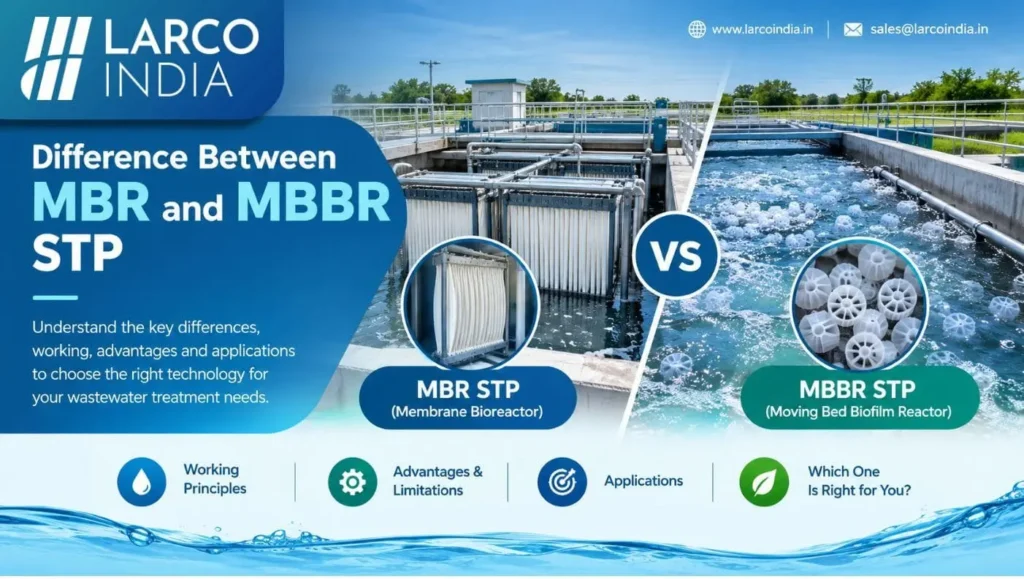
MBBR stands for Moving Bed Biofilm Reactor. It is a biological wastewater treatment technology in which specially designed plastic carrier media are added to an aeration tank.
Microorganisms grow on the surface of these carriers and form a biofilm. As air is supplied through the aeration system, the carriers remain in continuous movement inside the reactor. The microorganisms attached to the media consume and break down organic pollutants present in the wastewater.
After biological treatment, the treated water generally passes through a secondary clarification stage to separate biological solids from the treated water.
MBBR is commonly selected for STP applications because it provides effective biological treatment in a relatively compact system and can handle variations in wastewater loading when properly designed and operated.
What Is MBR STP?
MBR stands for Membrane Bioreactor. It combines biological wastewater treatment with membrane filtration.
In an MBR sewage treatment plant, microorganisms biologically degrade organic pollutants while membrane modules provide solid-liquid separation. Depending on the system design, microfiltration or ultrafiltration membranes can be used to produce highly clarified treated water.
Unlike a conventional biological treatment system that relies on gravity settling for final solid separation, MBR uses membranes as the separation barrier.
This makes MBR particularly useful where high-quality treated water, water reuse and a compact plant footprint are important considerations.
Difference Between MBR and MBBR STP
The main difference between MBR and MBBR is the method used for biological treatment and solid-liquid separation.
MBBR uses carrier media to support biofilm growth, while MBR combines biological treatment with membrane filtration.
The following table provides a simple comparison:
| Parameter | MBBR STP | MBR STP |
| Full Form | Moving Bed Biofilm Reactor | Membrane Bioreactor |
| Biological Treatment | Attached-growth biofilm | Biological treatment with membrane separation |
| Main Technology | Floating bio-carriers | Membrane modules |
| Solid Separation | Generally secondary clarification | Membrane filtration |
| Treated Water Quality | Good, depending on complete treatment train | Very high when properly designed and operated |
| Footprint | Compact | Generally more compact |
| Initial Cost | Generally lower | Generally higher |
| Energy Requirement | Moderate | Generally higher |
| Maintenance | Moderate | Higher due to membrane cleaning and management |
| Operator Skill | Moderate | Higher |
| Water Reuse | May require additional polishing | Strong option for high-quality reuse |
| Membrane Required | No | Yes |
| Suitable For | General sewage treatment and upgrades | Advanced treatment and water reuse |
Actual performance and operating costs depend on flow, wastewater characteristics, treatment objectives, plant design and operating conditions.
How Does an MBBR STP Work?
An MBBR sewage treatment plant generally involves several treatment stages.
Preliminary Treatment
Incoming sewage first passes through screening and other preliminary treatment equipment. Large floating materials, plastics, rags and other debris are removed to protect downstream equipment.
Primary Treatment
Depending on the plant configuration, primary treatment may include equalization or settling to reduce the load entering the biological treatment stage.
MBBR Biological Treatment
The wastewater enters the MBBR reactor containing floating bio-media. Air supplied through diffusers keeps the media moving and provides oxygen to microorganisms.
The microorganisms attached to the carrier media consume biodegradable organic matter and help reduce pollutants in the sewage.
Secondary Clarification
After biological treatment, the water generally passes into a secondary clarifier. Biological solids are separated through settling.
Tertiary Treatment and Disinfection
Depending on the intended reuse or discharge application, additional treatment such as pressure sand filtration, activated carbon filtration, ultrafiltration, UV or chlorination may be provided.
How Does an MBR STP Work?
An MBR sewage treatment plant combines biological treatment with membrane filtration.
Preliminary Treatment
Screening is particularly important in an MBR system because large solids and fibrous materials can damage or interfere with membrane operation.
Biological Treatment
The sewage enters the biological reactor where microorganisms break down biodegradable organic matter.
Membrane Filtration
The biologically treated wastewater is passed through membrane modules. The membranes retain suspended solids and microorganisms while allowing treated water to pass through.
Treated Water Reuse
The high-quality permeate produced by the MBR system can be suitable for various non-potable reuse applications, depending on the complete treatment design and applicable requirements.
MBR vs MBBR: Which Provides Better Water Quality?
One of the important factors in the MBR and MBBR difference is the final solid-liquid separation process.
MBBR normally relies on a clarification stage after biological treatment. Additional filtration or disinfection can be incorporated when higher-quality treated water is required.
MBR uses membrane filtration, providing a physical barrier for suspended solids and microorganisms. Therefore, MBR can produce highly clarified treated water and is often considered where water reuse or stringent treated-water quality requirements are important.
However, MBR should not automatically be considered the best solution for every project. The complete treatment objective, operating conditions and lifecycle cost should be evaluated before selecting the technology.
MBR vs MBBR: Space Requirement
Space availability is another important consideration.
MBBR can provide a compact biological treatment process because the carrier media provide a large surface area for microbial growth. However, the complete plant may still require a clarification stage and additional tertiary treatment.
MBR can reduce the overall footprint by combining biological treatment with membrane-based solid separation. This makes it attractive for projects where land availability is limited.
For example, commercial buildings, hotels, residential developments and urban facilities may consider MBR where space is a major constraint.
MBR vs MBBR: Cost
Cost is an important consideration when comparing MBR vs MBBR.
MBBR systems generally have a simpler treatment configuration and do not require membrane modules. This can make them more economical for projects where very high-quality treated water is not required.
MBR systems generally involve higher capital and operating costs because of membrane equipment, membrane cleaning, pumping and associated control systems.
Therefore, the lowest initial cost should not be the only deciding factor. The total lifecycle cost, water reuse benefits, available space, power consumption and maintenance requirements should also be evaluated.
Maintenance Requirements
MBBR systems require regular inspection and maintenance of blowers, diffusers, pumps, screens, clarifiers and other equipment. The condition and movement of the carrier media should also be monitored.
MBR systems require all the normal biological-treatment maintenance along with membrane-specific maintenance. Membranes need appropriate cleaning and operating control to minimize fouling and maintain stable performance.
Consequently, MBR generally requires a higher level of operational monitoring compared with a basic MBBR system.
Applications of MBBR STP
MBBR technology can be considered for a wide range of sewage treatment applications, including:
- Residential complexes
- Housing societies
- Hotels
- Hospitals
- Commercial buildings
- Educational institutions
- Industrial campuses
- Municipal and community applications
- STP expansion and upgrading projects
MBBR can be particularly useful when a reliable biological treatment process is required without the complexity of membrane filtration.
Applications of MBR STP
MBR technology can be considered for applications where high-quality treated water and water reuse are important, such as:
- Commercial complexes
- Hotels and resorts
- Hospitals
- High-density residential developments
- Institutional campuses
- Industrial facilities
- Projects with limited land availability
- Water recycling and reuse applications
The final technology selection should always be based on the project’s wastewater characteristics, flow, treatment objectives and reuse requirements.
Advantages of MBBR STP
Some key advantages of MBBR technology include:
- Effective biological treatment
- Compact biological reactor
- Good tolerance to variations in organic loading when properly designed
- No membrane system required
- Relatively straightforward operation
- Suitable for new STPs and plant upgrades
- Can be combined with tertiary treatment for higher water quality
Advantages of MBR STP
Important advantages of MBR technology include:
- High-quality treated water
- Excellent suspended-solids removal through membrane filtration
- Compact plant footprint
- Suitable for water reuse applications
- Reduced dependence on conventional secondary clarification
- Consistent filtration performance when properly operated
- Suitable for projects with stringent treated-water quality requirements
Which Is Better: MBR or MBBR?
There is no single answer to whether MBR or MBBR is better. The right choice depends on the requirements of the project.
MBBR may be a suitable choice when:
- The project has a moderate budget.
- Conventional biological treatment is sufficient.
- Land availability is reasonable.
- The treated water will undergo additional polishing if required.
- A relatively simple STP operation is preferred.
MBR may be a suitable choice when:
- High-quality treated water is required.
- Water reuse is a major objective.
- Available space is limited.
- Consistent solid separation is important.
- The project can support higher capital and operating requirements.
- Skilled operation and membrane maintenance can be provided.
Factors to Consider Before Selecting MBR or MBBR
Before selecting an MBR or MBBR sewage treatment plant, consider the following:
Sewage Flow
The average and peak flow rates should be evaluated before selecting the treatment technology.
Wastewater Characteristics
Parameters such as BOD, COD, TSS, nutrients, oil and grease and other wastewater characteristics influence the treatment design.
Treated Water Requirement
Determine whether the treated water will be discharged or reused for flushing, gardening, cooling or other non-potable applications.
Available Space
If the site has limited space, an MBR system may be considered because of its compact configuration.
Budget
Both capital cost and long-term operating expenses should be considered.
Operation and Maintenance
The availability of trained operators and maintenance support is important, particularly for membrane-based systems.
Future Expansion
The possibility of increasing treatment capacity in the future should also be considered during STP planning.
Conclusion
Understanding the difference between MBR and MBBR STP is essential when selecting a sewage treatment technology. MBBR uses moving bio-carriers to support microbial growth and provides an effective biological treatment solution. MBR combines biological treatment with membrane filtration to achieve a higher level of solid-liquid separation and treated-water quality.
MBBR can be an attractive choice for cost-effective biological treatment, while MBR can be advantageous for compact installations and projects focused on high-quality water reuse.
The best technology ultimately depends on the sewage characteristics, plant capacity, available space, treated-water requirements, budget and long-term operation and maintenance strategy.
Looking for a STP solution for your industry?
LARCO India provides customized water and wastewater treatment solutions for industrial, commercial and institutional applications.