
Water hardness is a common water-quality problem caused mainly by dissolved minerals such as calcium and magnesium. Hard water can result in scale formation, reduced efficiency of soaps and detergents, and mineral deposits in pipes, boilers, heat exchangers and other equipment. Water hardness is generally expressed as milligrams per litre (mg/L) as calcium carbonate (CaCO₃).
Permanent hardness is different from temporary hardness because it is mainly associated with dissolved calcium and magnesium salts such as chlorides and sulphates and cannot normally be removed simply by boiling.
In this article, we explain the methods to remove permanent hardness of water, how different treatment technologies work, and how to select an appropriate water treatment system for residential, commercial and industrial applications.
What Is Permanent Hardness of Water?
Permanent hardness of water is hardness caused mainly by dissolved calcium and magnesium salts that do not decompose easily when water is heated.
Common salts associated with permanent hardness include:
- Calcium chloride (CaCl₂)
- Magnesium chloride (MgCl₂)
- Calcium sulphate (CaSO₄)
- Magnesium sulphate (MgSO₄)
Unlike temporary hardness, permanent hardness cannot be effectively removed by ordinary boiling.
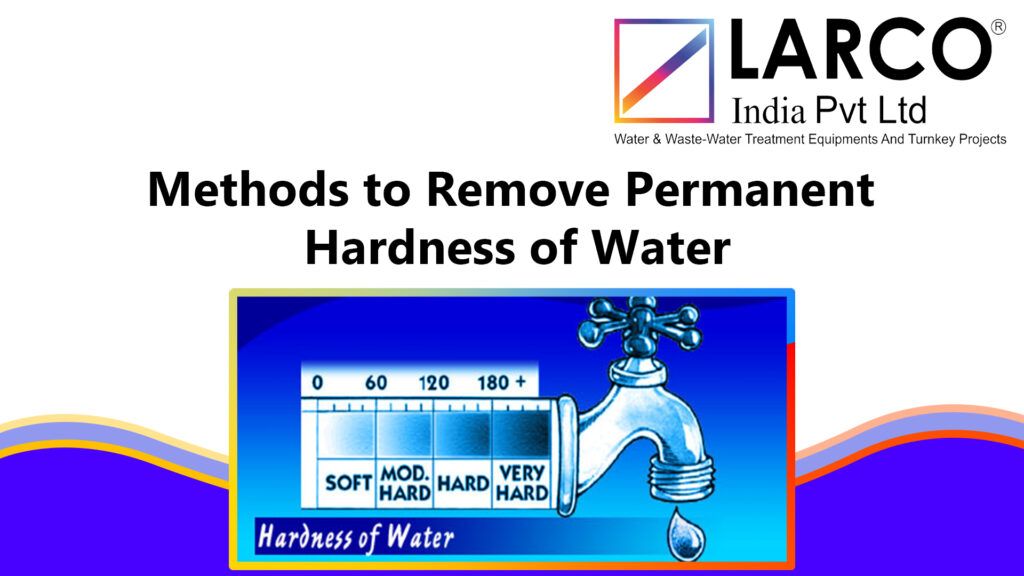
The concentration of hardness is commonly reported as *mg/L or ppm as CaCO₃*. USGS broadly classifies water as soft at 0–60 mg/L, moderately hard at 61–120 mg/L, hard at 121–180 mg/L and very hard above 180 mg/L as CaCO₃.
What Causes Permanent Hardness in Water?
Permanent hardness generally develops when groundwater or other water sources come into contact with mineral-bearing geological formations.
Calcium and magnesium can dissolve into groundwater and remain in solution. Depending on the source-water chemistry, these minerals can form salts such as chlorides and sulphates.
Common sources of permanent hardness include:
- Groundwater
- Borewell water
- Mineral-rich water sources
- Water passing through gypsum-bearing formations
- Water containing dissolved calcium and magnesium salts
- Industrial water sources with high mineral content
The actual hardness and water chemistry can vary considerably from one water source to another. Therefore, water analysis is important before selecting a treatment system.
Why Is It Important to Remove Permanent Hardness?
Hard water may create problems in both domestic and industrial applications.
When hard water is heated, calcium carbonate and other mineral deposits can form scale on heat-transfer surfaces. Scale can reduce heat-transfer efficiency and contribute to deposits in pipes, boilers, tanks and equipment.
Some common problems associated with hard water include:
- Scale formation in pipes and equipment
- Reduced heat-transfer efficiency
- Increased maintenance requirements
- Reduced efficiency of water heaters and boilers
- Soap and detergent inefficiency
- Mineral deposits on fixtures
- Operational problems in industrial processes
- Reduced performance of downstream water treatment systems
For industrial applications, controlling hardness can be particularly important when water is used as boiler feed water, process water, cooling water or as feed to additional purification systems.
How Is Water Hardness Measured?
Before selecting a water softening or hardness-removal system, the source water should be tested.
Water hardness is commonly expressed as mg/L as CaCO₃.
A water analysis may include:
* Total hardness
* Calcium hardness
* Magnesium hardness
* TDS
* pH
* Alkalinity
* Chloride
* Sulphate
* Iron
* Silica
* Electrical conductivity
Laboratory hardness testing can be performed using established analytical methods, including EDTA titration methods.
For industrial system design, hardness should not be considered in isolation. Flow rate, TDS, alkalinity, temperature and the required treated-water quality should also be evaluated.
Methods to Remove Permanent Hardness of Water
1. Ion Exchange:
Permanent hardness is often fought using ion exchange. The use of a resin bed containing sodium ions will include. Calcium and magnesium ions will be switched out for sodium ions, as the hardness of the water will reduce as it travels through the resin. This procedure successfully softens the water, making it appropriate for daily usage. It is crucial to remember that in order to refill the sodium ions, the resin bed needs to be periodically regenerated with salt.
2. Lime-Soda Process:
Methods to Remove Permanent Hardness of Water, Permanent hardness will eliminate chemically using the lime-soda technique. This procedure involves the reaction of calcium and magnesium ions in hard water with lime (calcium hydroxide) and soda ash (sodium carbonate) to produce insoluble precipitates. The softened water is then produced by removing these precipitates via sedimentation or filtration. Large-scale water treatment, like that required for municipal water supplies, frequently uses the lime-soda method.
3. Reverse Osmosis:
Reverse Osmosis (RO) is a very efficient technique for purifying water of additional contaminants in addition to persistent hardness. Water is forced through a semipermeable membrane throughout the process, which permits only water molecules to pass while rejecting impurities and dissolved minerals. Water hardness can be greatly reduced using RO systems, resulting in high-quality, softened water fit for a variety of uses. It is crucial to keep in mind, though, that RO systems can be expensive and could need routine upkeep.
4. Distillation:
The historic distillation method will remove water impurities and hardness. It includes heating water to a boil in order to create steam, which is then condensed back into liquid form, condensing the dissolved minerals in the process. Permanent and temporary hardness is successfully eliminated by distillation, producing clear, softened water. It is important to note, though, that distillation can be an energy-intensive process and might not be appropriate for large-scale applications because of how slowly it operates.
Additional Hardness- Control Approch
5. Chelation:
Chelation is a chemical treatment approach in which chelating agents bind calcium and magnesium ions in water. This can help control the effects of hardness and reduce scale formation. However, unlike ion exchange or reverse osmosis, chelation does not necessarily remove hardness ions from the water. Its suitability depends on the water chemistry and the intended application.
The hardness of water is brought on by the presence of calcium or magnesium salts in the water.
Temporary Hardness: It only comprises calcium and magnesium bicarbonate salts. Boiling can get rid of it, For Example:
Permanent Hardness – It contains calcium and magnesium chloride and sulphate salts. Boiling does not remove it. For instance.
Which Method Is Best for Permanent Hardness?
Ion exchange → when the objective is water softening
RO → when hardness reduction is required along with removal of other dissolved solids
Lime-soda → suitable for large-scale/high-hardness treatment
Distillation → where very high purity is required and energy consumption is acceptable
Chelation → Useful mainly for controlling the effects of hardness, such as scale formation, rather than physically removing hardness ions from the water
The appropriate treatment method depends on raw-water hardness, TDS, flow rate, required water quality and intended application. For industrial applications, a water analysis is recommended before selecting the treatment process.
Conclusion:
Permanent hardness of water is mainly associated with dissolved calcium and magnesium salts such as chlorides and sulphates. Because boiling does not effectively remove this type of hardness, an appropriate water treatment process is required.
The main methods to remove permanent hardness of water include ion exchange, lime-soda softening, reverse osmosis and distillation. Chelation may be useful in selected applications for controlling the effects of hardness but should not be confused with processes that actually remove hardness ions.
For most industrial applications, the right solution depends on the complete water analysis, required flow rate and desired treated-water quality.
LARCO India provides water treatment solutions including water softener systems, industrial RO plants, water treatment plants and dealkalization systems. A properly designed treatment system can help industries achieve the water quality required for their specific process and equipment.
If you are facing high hardness in borewell water, process water or industrial water, get the water analysed first and select the treatment technology based on the actual water chemistry and application requirements.
Need help selecting a water treatment system? Contact LARCO India for a customized water-treatment solution.
Need a Solution for Permanent Water Hardness?
Get reliable water softening and treatment solutions from LARCO India for effective hardness removal and improved water quality.